
Wedding ideas
Custom Wedding Song Gift Ideas That Put the Couple First
A custom wedding song works best when the giver chooses a clear point of view, a few recognizable memories, and a delivery plan that gives the couple room to listen.
Choose the job of the wedding song gift first
The most useful custom wedding song gift ideas begin with a job, not a genre. Decide what the song should do for the couple. It might welcome a new family member, thank the people getting married for the friendship they have shared, tell one partner what the wedding day means, or preserve a chapter that guests have watched unfold. One clear job gives the story a center and prevents the song from becoming a musical version of every speech at the reception.
Write the job in one plain sentence. “I want my sister and her partner to hear how much steadier they became together” is more useful than “make it emotional.” “I want my fiancé to know I am excited about our ordinary married life” is more useful than “write a romantic wedding song.” The sentence does not need to appear in the lyrics. It helps you decide which memories deserve space and which details only make the brief longer.
Keep the wedding and the relationship in different roles. The wedding explains when the gift is being given. The relationship explains why the gift matters. A song that only mentions vows, rings, and forever may fit the day but still feel interchangeable. Add the kitchen ritual, wrong train, family phrase, or quiet act of support that could only belong to this couple.
Match the point of view to the person giving it
A song from one partner to the other should sound different from a song given by parents, siblings, or friends. A partner can speak directly about the life they share and the future they are choosing. Parents may connect an earlier memory to the person their child has become, while still addressing both people as a couple. Friends can describe the changes they have observed without pretending to know every private part of the relationship.
State the point of view at the top of your notes: “This gift is from Lena, the bride’s college friend, to both Alex and Maya.” Add the pronouns and the form of each name the couple actually uses. If several people are giving the gift, decide whether the song can honestly say “we.” A group voice should use memories the group truly shares instead of borrowing intimate scenes from one person.
Read every draft line with the speaker in mind. If “I,” “we,” “you,” and “they” move around without a reason, the couple will have to solve the perspective while listening. Simplify the voice before music makes those changes harder to notice. Clarity is especially important when the gift welcomes someone into a family or combines messages from two sides of the wedding.
- Partner to partner: direct voice, shared life, and a personal message.
- Parents to the couple: a warm welcome and memories that honor both people.
- Friends to the couple: witnessed moments and a wish for their next chapter.
- Group gift: only use a collective voice where the experience is truly shared.
Build a small memory bank instead of a full biography
Start with six short notes: one place, one habit, one challenge, one phrase, one turning point, and one hope. You will not need all six in the final song. The exercise gives you enough range to discover a thread without trying to summarize an entire relationship. A memory bank should be specific enough that the couple recognizes it but short enough that you can compare the details and remove the weaker ones.
Physical details often carry emotion better than adjectives. The dented kettle from the first apartment, a map kept from a rainy trip, or the porch light one partner always leaves on can show loyalty, humor, or home without naming those qualities directly. Ask what happened around the object and what it means now. The object is an anchor, not decoration.
Include at least one ordinary scene. Wedding gifts naturally lean toward major milestones, but daily life is where the couple will test the promises celebrated that day. A song can mention the proposal while letting Sunday grocery trips or late-night tea reveal the relationship. That balance helps the lyrics feel like a gift to two real people rather than a generic tribute to marriage.
- One place both people can picture immediately.
- One routine that shows how they care for each other.
- One obstacle they handled together without exposing private pain.
- One sentence the giver genuinely wants them to remember.
Decide what should stay outside the song
Personal does not mean unrestricted. Remove medical information, money problems, old relationship history, private arguments, and stories about other people unless the couple has clearly welcomed those details. A wedding audience can make a familiar joke feel different. Read each note as if it were being sung in front of the most cautious listener in the room. If that thought creates hesitation, keep the detail for a private conversation instead.
Be careful with humor. A good shared joke lets the couple feel recognized. A risky joke asks one person to laugh at themselves while everyone watches. Choose moments where both people own the story, and avoid details that need a defensive explanation afterward. The song can be playful without turning the recipient into the subject of a roast.
The delivery plan should influence the privacy level. A song intended for a private link can hold quieter and more personal material than one used during dinner. If the final setting is uncertain, write for the smaller audience. The couple can always choose to share the song later; they cannot pull a private lyric back after it has been played publicly.
Shape the story around one meaningful change
Look across the memory bank and ask what changed because these two people found each other. Perhaps one became braver about moving, both learned to slow down, or a difficult year turned two separate routines into a shared home. The change gives the song movement. It creates a beginning, a middle, and a wedding-day message without requiring you to list every date in order.
A simple arc has three parts. Open inside one scene so the listener can see where the story begins. Move toward the realization that made the relationship matter. End with the message the giver wants to place beside the vows. This structure can support tender, playful, or reflective music because it is based on meaning rather than a predetermined sound.
Test the central idea for repetition. “You were meant to be” is broad enough for almost any couple. “You made the wrong city feel like home” points back to a real chapter and can hold a chorus without becoming a slogan. If the main line belongs equally well on a mass-produced card, return to the memory bank and find the evidence behind it.
Plan a listening moment that fits the couple
A wedding song gift does not have to become a ceremony performance or first-dance track. Those moments carry schedules, sound checks, venue rules, and strong expectations. A quiet reveal before the guests arrive, a few minutes after the ceremony, breakfast the next morning, or a private message after the honeymoon can give the couple more room to listen. Choose the moment around their comfort, not around the size of the gesture.
If the couple enjoys sharing emotions publicly, a small group can work. Make sure the people present belong to the story and that the lyrics do not expose anyone who did not agree to the moment. If either partner is private, let the card introduce the song and make it clear that listening later is welcome. Permission to wait can make a digital gift feel more thoughtful, not less important.
Have a simple backup. Wedding timelines change, speeches run long, and the available sound system may not match the plan. The backup can be as small as handing over the card and private link. The gift remains complete even if it is never played to a room. That resilience is one advantage of treating the song as a personal keepsake rather than a live production.
- Before the ceremony: useful for a private partner-to-partner message.
- After the ceremony: a calmer option for parents or close friends.
- In a small trusted group: only when the lyrics fit that audience.
- Later by private link: ideal when the wedding day is already full.
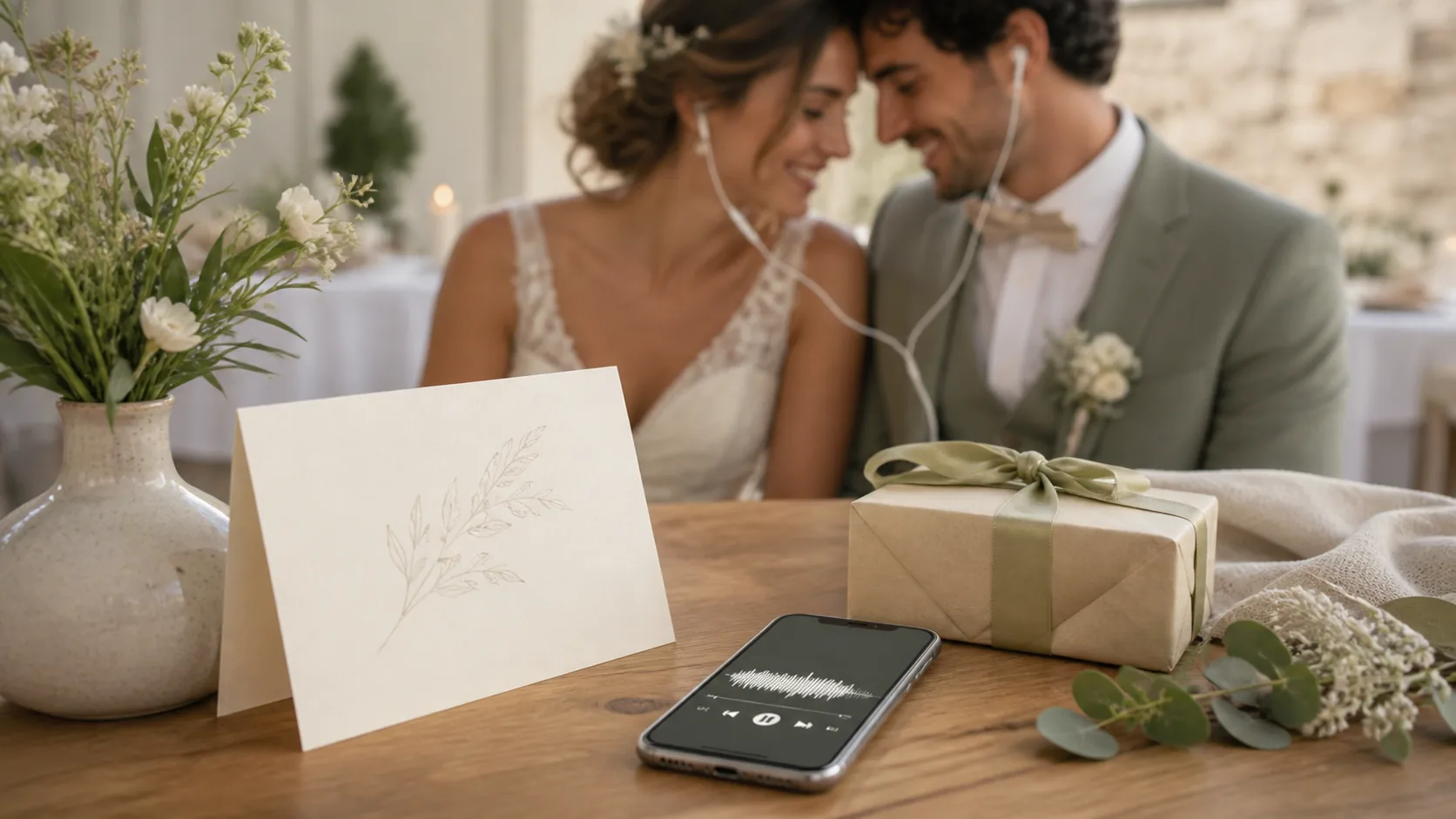
Pair the song with a card and private link
A card gives the gift a physical beginning without trying to contain the entire story. Write one sentence about the memory that started the idea and one sentence about when the couple might listen. Avoid summarizing every verse. Let the song reveal its own details. A short note in your normal voice will usually feel more personal than formal wedding language copied from a template.
After a version is unlocked, a private gift page can keep the full song, lyrics, cover, and dedication together. The couple can open that page without creating an account. Check the cover, message, and selected version before sending the link. Share it only with the intended recipients rather than treating it as a public wedding page. The couple should control whether the song reaches a larger audience later.
Do not use the card to demand a reaction. Lines such as “play this in front of everyone” or “this will make you cry” turn the gift into a test. Offer context instead: “This began with the story of the rainy move, and you can listen whenever the day becomes quiet.” The wording protects the couple’s freedom while showing that the link is more than an unexplained attachment.
Review every lyric before comparing the previews
Read the complete title and lyrics before generating music. Check spelling, names, pronouns, family roles, places, and the sequence of important events. Then check emotional accuracy. Does the song claim that one person rescued the other when the relationship was more balanced? Does it promise a future the couple has not discussed? Does a polished line quietly replace the truth? Correct those problems while the words are still easy to inspect.
Melodank lets you edit the full English lyrics before music generation. After sign-in, it creates two complete versions and provides a 60-second preview of each. Listen once for emotional fit and again for clarity. Notice whether the names sound natural, whether the central memory arrives early enough, and whether the arrangement leaves room for the words. The better gift version is not automatically the louder or more dramatic one.
One song credit unlocks the chosen version for full online playback and the private gift page. A one-time credit does not automatically include an MP3 download; that remains a separate add-on unless the song was unlocked with a subscription credit that includes a download right. Build the delivery plan around the private page and listening moment so the gift does not depend on an entitlement that may not be included.
Use a practical wedding song gift checklist
Before creating anything, confirm five items: the giver, the recipients, the purpose, the memory thread, and the delivery setting. Then mark any private details that must stay out. This short brief is enough to start. You do not need finished lyrics, a melody, or professional production language. Plain, accurate notes give the lyric review stage much better material than a page of wedding adjectives.
After the draft appears, verify every fact and read the words aloud. Compare the two previews with the couple and occasion in mind. Unlock only the version that supports the message, add a restrained cover and dedication, and test the private link. Prepare a physical card if that suits the wedding, but keep the handoff simple enough to survive schedule changes.
The best custom wedding song gift ideas do not depend on studio recording, unlimited revisions, instant delivery, a public performance, or a music-platform release. They depend on attention: noticing the couple’s real life, choosing a respectful point of view, and creating a moment where the two people can hear the message without pressure. That is what turns a generated song into a considered wedding gift.
- Name the giver and recipient perspective clearly.
- Choose three to five specific shared memories.
- Remove details that should not be sung or shared.
- Review the complete lyrics and both 60-second previews.
- Prepare the card, dedication, private link, and backup listening moment.
Keep reading
Plan the wedding song
Start with the giver, the couple, and three recognizable memories, then review every lyric before turning the story into music.
Create a song